

As today is April 1st, better known as April Fools’ Day, we thought we’d separate the truth from the tricks in a special quiz. Below are ten ‘facts’ about literary works or famous writers which may be true or may be utterly false (but often believed to be true). Can you tell the the facts from the fiction? Or will you end up fooled? We’ll put the questions in the top half, and the answers and explanations underneath. Tell us how you do in the comments below, and invite your friends and family to take the fiendish foolish quiz!
1. In the 1980s, John Steinbeck’s novel The Grapes of Wrath was translated into Japanese as ‘The Angry Raisins’.
2. Book paper almost always catches fire and burns at 451 degrees Fahrenheit, hence the title of Ray Bradbury’s novel.
3. One of Dylan Thomas’s first published poems was plagiarised from a comic called the Boy’s Own Paper. This wasn’t discovered for forty years.
4. In 1910, Virginia Woolf and her friends dressed up as Abyssinian royalty and succeeded in tricking the British Royal Navy into giving them a guided tour of the HMS Dreadnought.
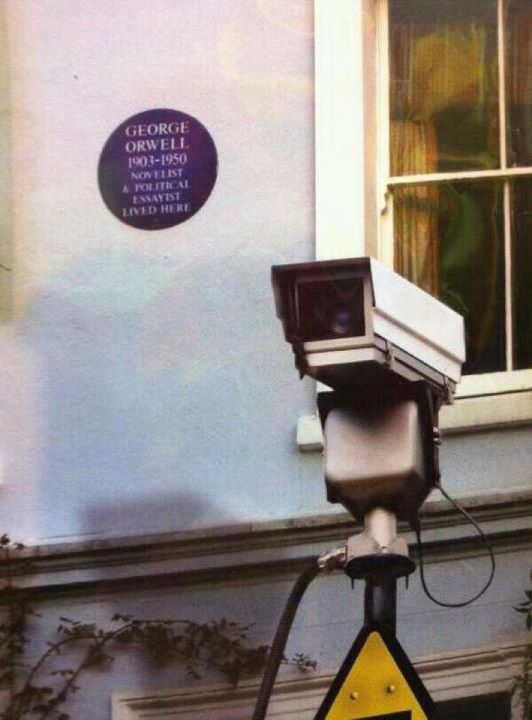
5. Ironically, there is a CCTV camera outside George Orwell’s old house – directly beside a blue plaque commemorating the man who wrote ‘Big Brother is watching you’.
6. Herman Melville’s classic novel Moby-Dick gave the coffee-house chain Starbucks its name.
7. Robert Browning used the word ‘twats’ in his 1841 poem Pippa Passes, because he laboured under the mistaken belief that the word referred to ‘a piece of headgear worn by nuns’.
8. An Italian translation of Orwell’s Nineteen Eighty-Four has the clocks striking ‘uno’ instead of thirteen because, according to the translator, ‘Italian clocks don’t go up to thirteen’.
9. Queen Victoria enjoyed Alice’s Adventures in Wonderland so much that she requested a first edition of Carroll’s next book. Carroll duly sent her a copy of the next book he published – a mathematical work with the exciting title An Elementary Treatise on Determinants.
10. The Woozle effect is the name given to the phenomenon when an incorrect fact is repeatedly cited, and thus attains the status of urban legend.
So, how did you do? Find out below…

2. False. Contrary to what Bradbury says at the start of his novel, Fahrenheit 451, book paper almost never catches fire at 451 degrees Fahrenheit – there is no set temperature for the auto-ignition of paper. The temperature is usually much higher (nearer 480 degrees) and even at that temperature, a thick book would take a while to auto-ignite. Bradbury’s novel predicted, among other things, ATMs, flat-screen televisions, Bluetooth technology, and rolling news.
3. True. Thomas himself appears to have admitted the theft in an autobiographical story of 1940, thirteen years after the poem had appeared in print: ‘A poem I had had printed in the Western Mail was pasted on the mirror to make me blush, but the shame of the poem had died. Across the poem I had written with a stolen quill and in flourishes: “Homer Nods”.’ More on this story can be found at the blog of the Dylan Thomas Society.
4. True. We’ve written about this story in our anniversary post containing our twelve best facts from the first year of this site, but you can find out more about Woolf’s politically incorrect shenanigans in this Guardian article.
5. False. This photograph often does the rounds on Twitter and other websites, but it appears that it is not true, alas – the irony would be too delicious. There is a discussion about the picture here.
6. True. However, Moby-Dick wasn’t a classic in Melville’s own lifetime: for instance, between 1863 and 1887, an average of 23 copies of Moby-Dick were sold each year. It now sells more copies each year than were sold in the entire nineteenth century. Melville gave up writing soon after its publication: his last novel, the 1857 work The Confidence-Man, centred on the idea of a confidence trickster or con-man (then a new idiom in American society). The novel, which is all about a man who fools people, was set on one single day, April Fool’s Day, and was appropriately enough also published on April the 1st. However, the book was not a success, and after this, Melville gave up writing, and lived out the remainder of his life as a customs house official.
7. True. Browning had come across the word ‘twat’ in an old bawdy poem called ‘Vanity of Vanities,’ a poem of 1660, which contains the misleading lines: ‘They’d talk’t of his having a Cardinalls Hat, / They’d send him as soon an Old Nuns Twat.’ He got the wrong end of the stick and thought this must be part of a nun’s habit. His friends were too embarrassed ever to broach the subject with him…
8. True. This story is recounted by literary scholar John Sutherland in his book Where Was Rebecca Shot?. It appears to be true, and Sutherland’s credentials are impeccable, but if anyone knows otherwise – it does have the ring of legend about it – we’d like to know!
9. False. Unfortunately, like most good anecdotes, this one isn’t true: Carroll himself denied this exchange ever happened. But it does neatly encapsulate Carroll’s double life as both conservative Oxford mathematician Charles Dodgson and radical children’s author Lewis Carroll.
10. True. The phenomenon is named after the Woozle, a fictitious animal which features in Winnie-the-Pooh. Pooh and Piglet go hunting for the fabled Woozle, but they are unsuccessful. Christopher Robin later explains that they have in fact been following their own tracks around a tree.
Image: Jester reading a book, c. 1896, artist unknown, public domain.
